
Evidence01
- Nessusreport
 OpenVASreport
- Rapid7 InsightVMreport
- Qualysreport
Cube reads the reports your scanners already produce, adds the business context they never see, and returns a decision you can defend — inside your perimeter, on your model.


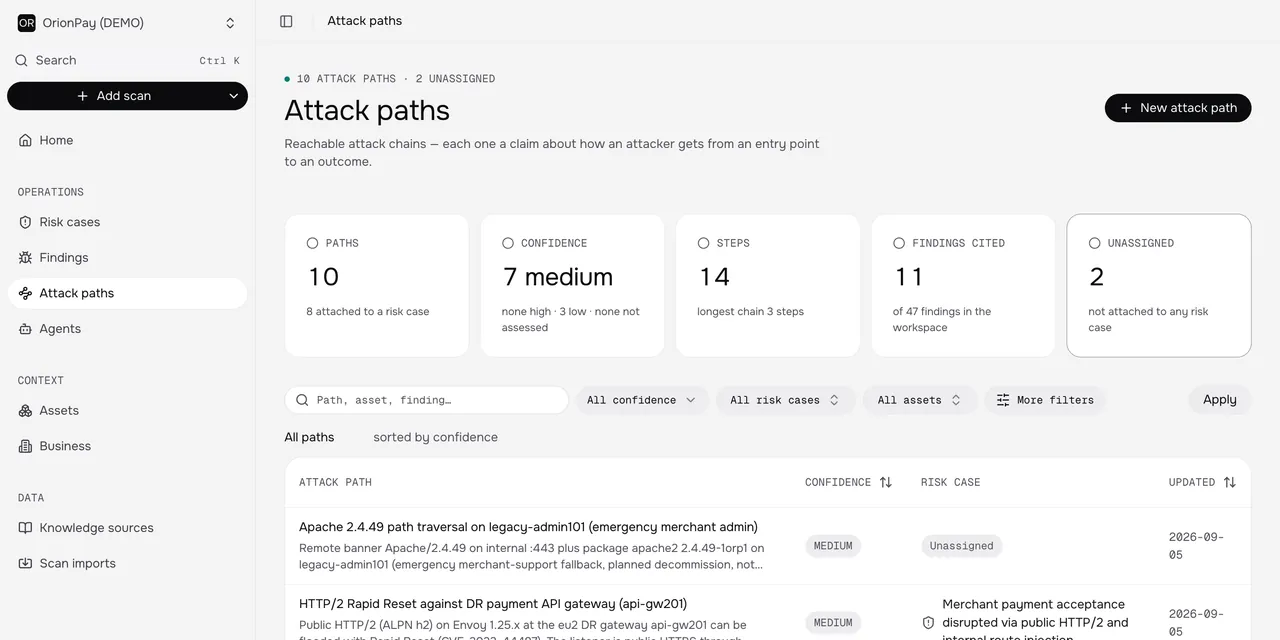
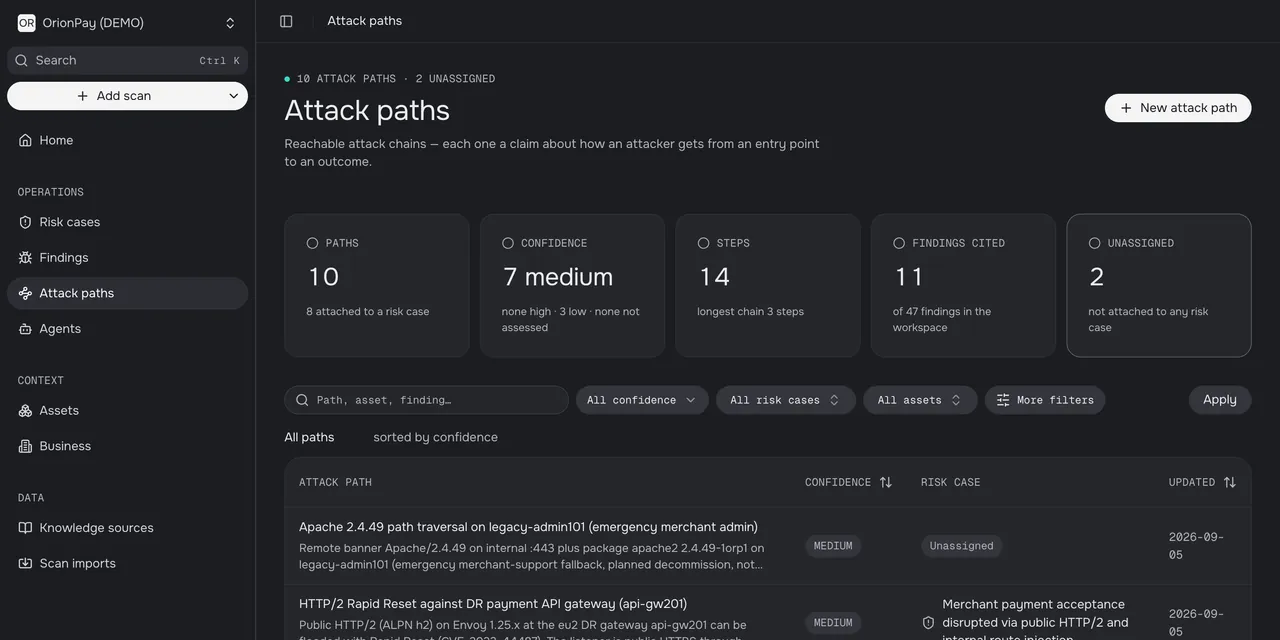
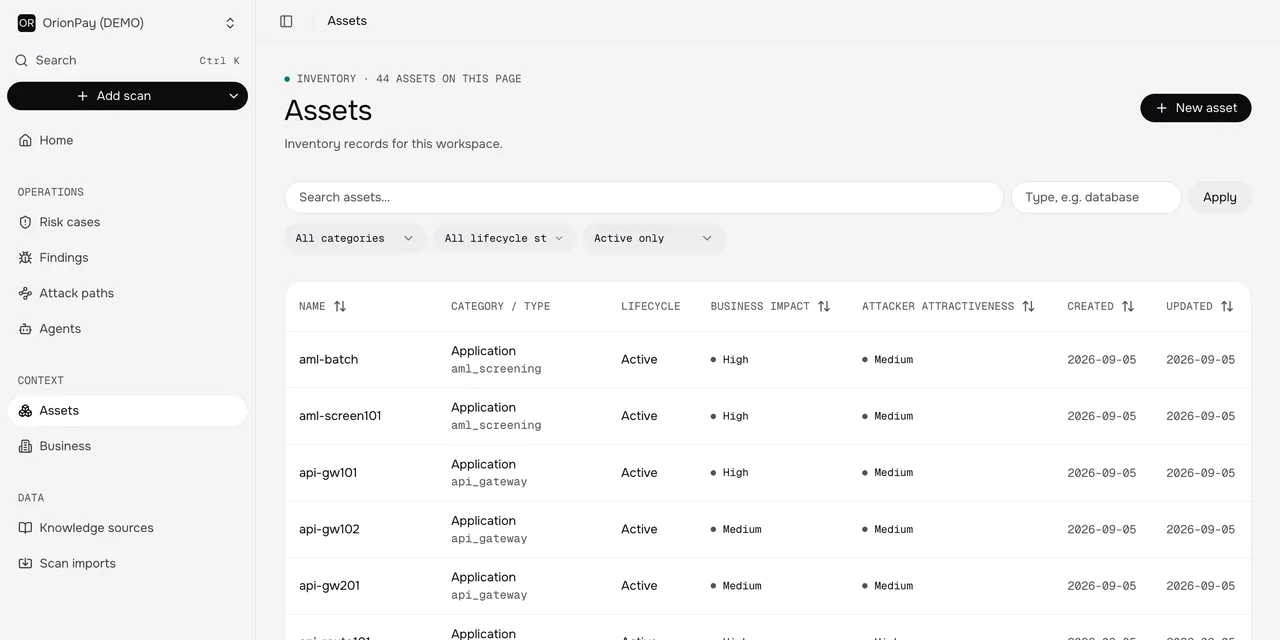

Triage About 10× fewer risk cases than findings — the queue your team actually works.
Security chaos starts when the context lives somewhere else:
scanners produce CVEs, not business capabilities.
“The score doesn’t know my network”
Scanner severity is computed without your assets, exposure or controls. The ranking you get is not the ranking you need.
“I can’t read 3,000 findings”
Findings arrive faster than any team can triage them by hand.
“I can’t explain my choice”
The business asks what it costs. Auditors ask why this and not that. A spreadsheet of scores answers neither.
Cube collapses findings into roughly 10× fewer risk cases — that is the queue your team actually works.
Unified evidence gives the model something real to reason over, business context tells it what the asset is worth, and the decision layer turns that into a call your board and your auditor both accept.
Read every scanner report as it is
Cube reads the reports your scanners already produce — Nessus, OpenVAS, Acunetix and others — and resolves every finding onto a real asset. There is no connector to build.
Know what the asset is worth
Assets, relationships, compliance scope and the business capabilities behind them, built from the infrastructure documents you already have. This is the part a scanner never sees.
Return a call you can defend
The CISA SSVC model run against your environment: exploitation, exposure, mission impact, attacker utility. Every step stays open to review and correction.
The same Log4Shell finding — what your scanner shows you today, and what you would have to work out on your own.
What you see today
Apache Log4j2 JNDI lookup remote code execution.
What you do not see
Tokenization API in eu1 — replaces PANs with tokens, sits at the core of the PCI CDE.
What you no longer do by hand
Exploited in the wild, reachable from the merchant portal, and it carries card-data protection.
What you can finally say
A sentence you can say to the CFO — not a CVE number.
Prioritisation only earns trust when it also takes work away.
Track
Critical RCE on an internal build server. No inbound path from outside, nothing in the payment flow behind it, no active exploitation.
Stays in the queue. Nobody works the weekend for it.
Act
Medium-severity flaw on the public payment gateway. Reachable from the internet, and merchant payment acceptance sits behind it.
Fixed today, with the reasoning written down.
Same scanner. Same morning. Your severity column ranks them the other way round.
Keep your scanners and workflows. Cube adds the missing decision layer: business context, transparent reasoning, and human control.
| Your current stack | What Cube adds | |
|---|---|---|
| Scanner output | Findings, severities, and alerts | A decision layer with the reasoning shown |
| Context | Technical issues in isolation | Tied to your asset graph and business processes |
| Business view | Security data and business impact stay disconnected | Risk cases the business can understand |
| Control | Manual triage or opaque automation | Transparent reasoning with human correction |
| Auditability | Notes, tickets, or spreadsheets | Evidence, author, and timestamp in every record |
| Deployment | Integration-heavy rollout | First results in hours, inside your boundary |
Any scanner report goes in — no connector to build. Out comes a decision with the reasoning attached.
Scan reports · any scanner
OpenVASInfrastructure knowledge
SSVC decision
A business-readable statement with impact and materiality.
The technique chain across your real asset graph, mapped to MITRE ATT&CK.
Org-wide posture and a board-ready executive brief.
Connect business impacts with assets. Understand attacker attractiveness.


Business impact targets provide a clear view of the real risks.
Cube connects scanner findings with environment context and business impact — turning technical issues into cases you can act on.


Technique chains across your real asset graph, mapped to MITRE ATT&CK.
What the screen shows
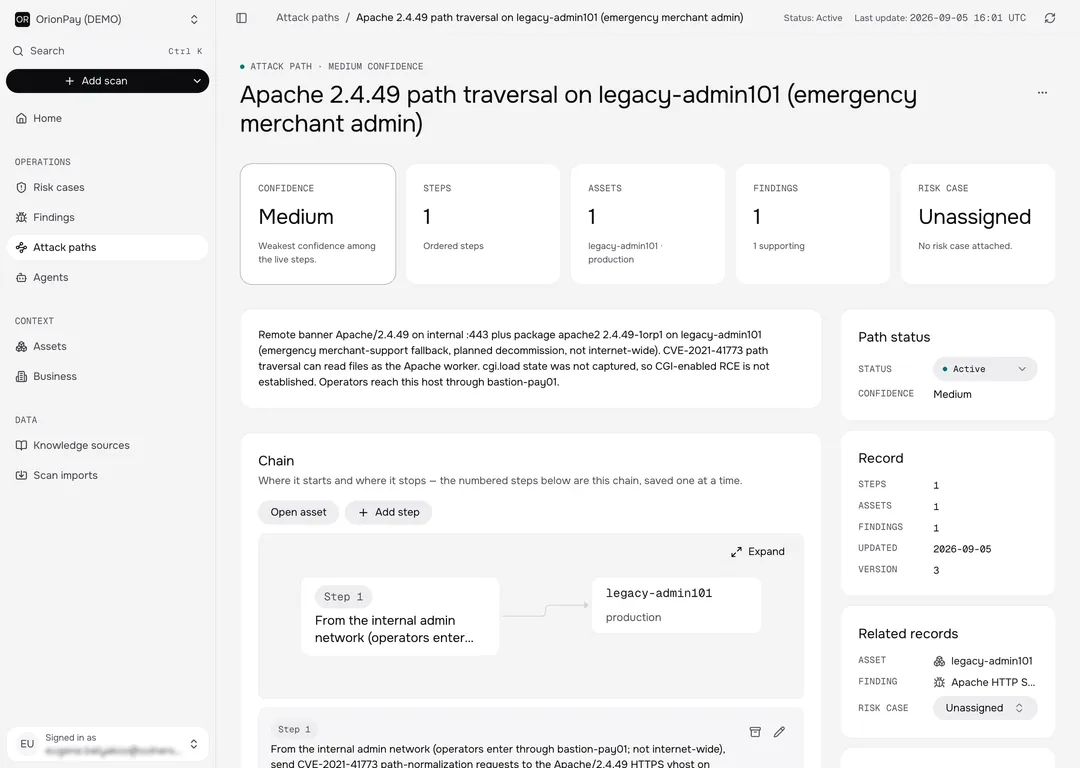
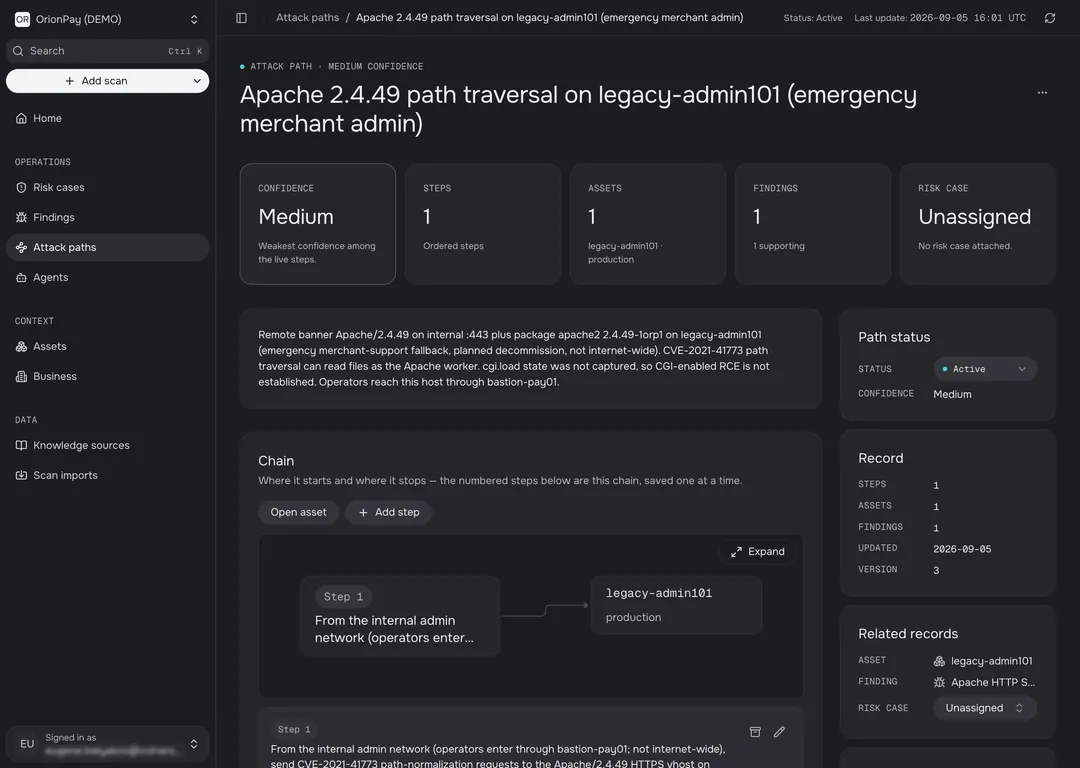
Keep security and engineering aligned by turning the same exposure
into the context each team needs to act.
See which asset is affected, which team owns it, what business capability is at risk, and what work should move first — so engineering can act without blindly derailing the roadmap.
See the exposure in business terms, with clear accountability, business impact, and rationale — so every decision stands up to the board, the auditor, and the business.
Every decision Cube makes carries the evidence, the business context and the rule it was decided by — exportable, reproducible, auditable.
Cardholder-data scope is a business attribute, not a CVSS score. Cube tags the assets that carry it and ranks their findings first.
Systems processing personal data get their own materiality weight, so a medium CVE on a PII store outranks a critical on a test box.
Every remediation decision keeps its evidence trail — what was found, why it mattered, what rule fired, who acted.
Financial-reporting systems are marked as such, and changes to their risk posture are reproducible on demand.
Deployed in your perimeter. Your model, your data, your retention policy — nothing leaves the environment you control.
The same risk record serves three audiences: business sees the impact and priority, security sees the reasoning and technical context, audit sees the evidence, author, and timestamp.
What the risk means for the business — impact, exposure, priority.
Why the AI reached this conclusion, step by step, open to correction.
Every claim traceable to a source a reviewer can open, with author & timestamp.
Every AI output carries its reasoning, and you can correct it and regenerate. The AI never has the final word.
Three steps to first results — and exactly what we need from you.
Cube needs an LLM. Point it at any endpoint speaking the OpenAI or Anthropic protocol, inside your perimeter.
Upload infrastructure documents and scan reports. Cube builds the asset graph and maps findings onto it.
Risk cases, attack paths and a threat profile — each one carrying the reasoning behind it.
The six things a technical reader asks before anything else.
Any popular scanner report — Nessus, OpenVAS, Acunetix and others. The model reads the report file, so there is no per-scanner connector.
A product integration API comes later.
Yes — it is the core of the product. Cube speaks the OpenAI and Anthropic protocols, on an endpoint inside your perimeter.
Recommended: grok 4.6, DeepSeek-V4-Pro, GLM 5.3.
No. Cube consumes scanner output and adds the decision layer your scanners cannot provide.
Nowhere. The platform and the model both run inside your boundary.
No. CVSS becomes one input into the SSVC decision, alongside exposure and business impact.
Hours from the documentation you already have — not weeks of integration work.
Bring the infrastructure docs you already have, and we’ll stand up a pilot on your own environment — typically within a day. You keep the results, the decisions and the full audit trail.
We’ll reply within one business day. No spam — ever.
We’ll reply within one business day.